Table of Contents
- Why the Best Time for Rocket Launches Is Rarely a Single Answer
- How to Read a Cape Canaveral Rocket Launch Schedule
- Rocket Launch Window Explained: Why Liftoff Times Shift
- Day vs. Night Rocket Launches: Which Is Easier to See?
- Converting Launch Times to Your Local Clock
- Rocket Launch Viewing Tips for Weather, Distance, and Timing
- Planning a Launch Day: Arrival, Parking, and Family Logistics
- Conclusion
- Frequently Asked Questions
Last Updated: October 19, 2026
Why the Best Time for Rocket Launches Is Rarely a Single Answer
The best time for rocket launches is whenever a mission is scheduled and the sky is clear enough to see it. That sounds like a dodge, but it's the honest answer. Launch times are set by orbital mechanics, mission goals, and range rules, not by what's convenient for spectators.
At Cozy Canaveral Cottages, we field this question constantly from guests planning a Space Coast trip. Here's the truth: there is no universal "golden hour" for watching a launch. A night launch and a midday launch are completely different experiences, and both can be spectacular.
What you actually need is a system for finding the scheduled time, converting it to your local clock, and knowing which conditions make a launch easy or hard to see. Below, we'll walk through exactly how to do that.
How to Read a Cape Canaveral Rocket Launch Schedule
A launch schedule is a live document, not a fixed calendar. Treat it that way and you'll avoid most disappointments.
The Cape Canaveral rocket launch schedule lists each mission with a target date, a window, and a launch site. Schedules shift for weather, range conflicts, and technical holds. Check the official schedule from the launch provider and the range operator before you plan anything around it.
Here's what to look for on any schedule entry:
- Target date and window - the day and the time range for liftoff
- Launch pad - different pads have different viewing angles
- Mission type - crewed, cargo, or satellite missions have different rules
- Backup dates - a sign the window is tight
Public schedules from NASA's launch schedule are a reliable starting point for upcoming missions. Cross-check with the operator's own feed the day before.
Pro Tip Screenshot the schedule the morning of the launch. If a scrub happens, the updated time often appears on social feeds before the main schedule page refreshes.Rocket Launch Window Explained: Why Liftoff Times Shift
A rocket launch window is the period during which a rocket can lift off and still complete its mission. Miss that period and the launch scrubs, sometimes for a full day.
The window exists because rockets must reach a precise point in orbit at a precise moment. For missions that rendezvous with a space station or deploy satellites into a specific plane, the window can be just seconds long. For others, it stretches across hours.
Three things move the window:
- Orbital targets - the rocket must meet a moving object or a specific orbital path
- Weather and range safety - clouds, wind, and lightning rules can delay liftoff
- Vehicle readiness - technical holds push the clock back in real time
That's why "what time is the launch" has a moving answer. The scheduled launch time is a target, not a promise. A scrub or rescheduled launch is routine, not a sign something is wrong.
Day vs. Night Rocket Launches: Which Is Easier to See?
If you want a single answer: the best time of day to watch a launch is usually the 30 to 60 minutes after sunset or before sunrise, followed by deep night, with midday last. That ranking comes from how sunlight hits the exhaust plume, not from the rocket itself.
Here is the mechanism. A rocket's flame is bright, but the plume, the expanding cloud of exhaust, is what makes a launch visible for dozens of miles.
A few practical consequences follow from that:
- Twilight launches often produce the most dramatic visible plume, including the expanding halo effect, because the vehicle is sunlit while the ground observer is in shadow.
- Deep-night launches are the easiest to spot from far away, a bright arc and a moving light are visible against a dark sky, but the plume itself may be less illuminated, so you see a point of light rather than a glowing cloud.
- Midday launches are the hardest to see from a distance and the easiest to photograph, because you have plenty of light and a fast shutter speed can freeze the vehicle.
| Factor | Midday Launch | Twilight Launch | Deep-Night Launch |
|---|---|---|---|
| Visibility from far away | Low to moderate | High | High |
| Plume drama (glow, halo) | Low | Highest | Moderate |
| Photography ease | Easiest | Moderate | Harder without gear |
| Family logistics | Simple | Simple | Requires late-bedtime plan |
| Crowd levels | Higher | Higher | Often lighter |
Distance and direction change the answer more than most people expect. If you are close to the pad, within a few miles, a daytime launch is perfectly visible and arguably more impressive because you can see the vehicle's shape and the pad structure.
For families with young children, a daytime or early-evening launch usually wins on practicality. A twilight launch is often the best compromise: dramatic visibility, but an earlier bedtime than a deep-night attempt. Deep-night launches are worth the late night if your kids can handle it and you want the easiest possible spot from a distance.
Key Takeaway The short answer to "when is the best time to watch a launch" is twilight first, night second, day third, then adjust for how far you are from the pad and which way the rocket is flying.Converting Launch Times to Your Local Clock
Most launch schedules publish times in the launch site's local time, Eastern Time for Cape Canaveral, and often list UTC alongside. If you are watching from another region, the conversion is the step most likely to make you miss a launch, especially when the window crosses midnight.
Use this method rather than guessing:
- Identify the published time zone. Schedules from the launch provider and the range operator typically show local time at the pad, sometimes with UTC in parentheses. Confirm which one you are reading before you convert.
- Convert to UTC first. UTC is the common reference, so going through it avoids daylight-saving confusion on both ends. Eastern Time is UTC−5 in winter (Eastern Standard Time) and UTC−4 in summer (Eastern Daylight Time) (Local Time FAQs | NIST).
- Convert from UTC to your local zone. Add or subtract your own offset, and check whether your region is observing daylight saving at that date.
- Check the calendar date, not just the hour. A late-evening Eastern Time launch can fall on the next day in UTC, and an early-morning UTC launch can fall on the previous day in the Americas.
Worked examples, using a launch listed at 8:00 p.m. Eastern Time:
- Pacific Time: 5:00 p.m. the same day (Eastern is three hours ahead during daylight saving).
- Central Time: 7:00 p.m. the same day.
- Mountain Time: 6:00 p.m. the same day.
- UTC: 12:00 a.m. (midnight) the next calendar day during daylight saving, or 1:00 a.m. the next day during standard time.
- Central European Time: 1:00 a.m. or 2:00 a.m. the next day, depending on the season and the offset in effect.
A launch window that spans two dates makes this harder. If a window runs from 11:30 p.m. to 1:15 a.m. Eastern Time, the early part of the window is one calendar day and the later part is the next. When you convert, keep the date attached to each end of the window rather than treating it as a single clock time.
Watch Out The most common mistake is forgetting the calendar day shift. A late-evening Eastern Time launch can fall on the next day in UTC, and a window that crosses midnight can straddle two dates in your local zone. Double-check the date, not just the hour.A simple habit that prevents most errors: write the launch time down in UTC, then convert once to your local zone, and note the date next to both. If the schedule updates, repeat the conversion rather than adjusting the old number in your head.
Rocket Launch Viewing Tips for Weather, Distance, and Timing
Weather, distance, and timing decide whether you see a launch or just hear about it. Cloud cover is the biggest spoiler. Even a clear forecast can hide a launch behind a low deck of clouds.
For rocket launch viewing tips, focus on three things:
- Cloud cover - check the forecast for the launch window, not the whole day
- Viewing distance - closer is better for daytime, less critical at night
- Viewing location - pick a spot with an open horizon toward the launch pad
A real-time schedule update from the range or provider will tell you if weather is threatening a scrub. Plan a backup activity so a delay doesn't wreck the day.
Key Takeaway The best viewing plan assumes the launch might slip. Build a flexible schedule around the window, not a single fixed minute.Planning a Launch Day: Arrival, Parking, and Family Logistics
Arrive early, expect security checks, and bring more water and snacks than you think you need. Launch days draw crowds, and parking near popular viewing areas fills fast.
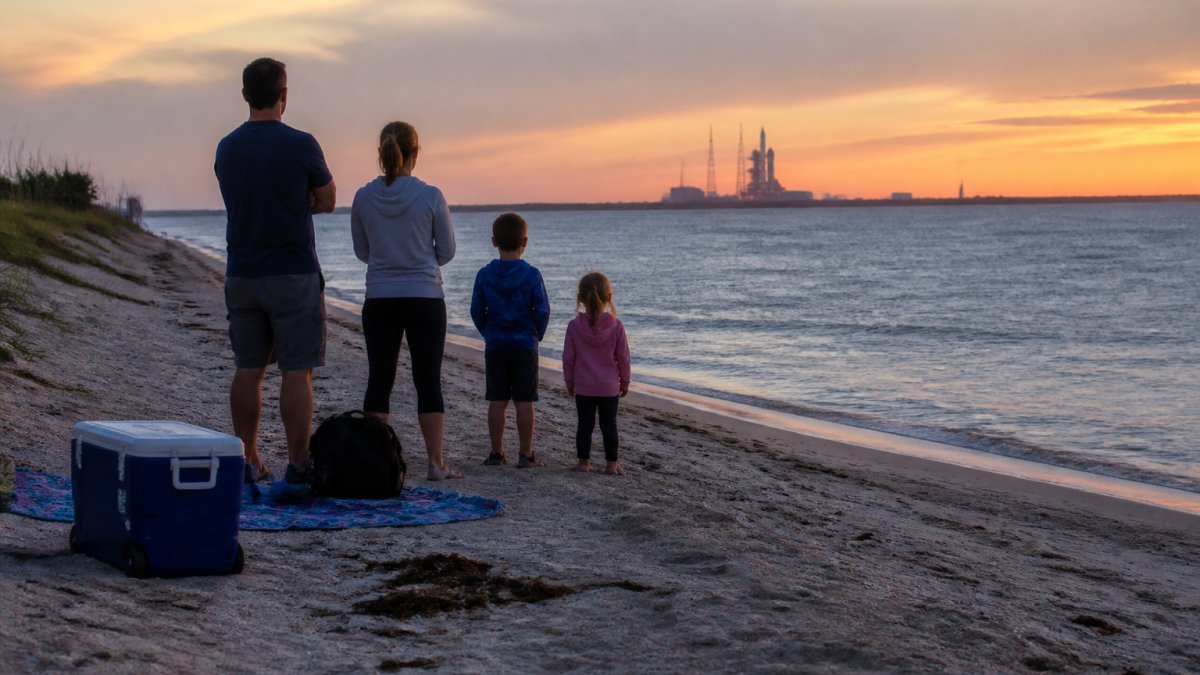
A simple launch-day checklist:
- Confirm the launch time the morning of
- Check the weather forecast for the window
- Arrive at your viewing area well before the countdown
- Pack water, snacks, sunscreen, and bug spray
- Bring a light jacket for evening launches
- Plan a backup activity in case of a scrub
For families, the key is keeping the wait comfortable. A cooler, blankets, and a shaded spot make a long countdown far easier on young kids. After the launch, expect traffic leaving viewing areas to move slowly, so plan a relaxed exit.
Our cottages sit just over a block from the beach, which makes a low-stress launch day possible: watch from the sand, then walk back to a private pool and a quiet yard instead of sitting in exit traffic.
Conclusion
The best time for rocket launches depends on the mission, the window, and the sky above you. Check the schedule, convert the time, watch the weather, and stay flexible.
If you're planning a Space Coast trip around a launch, Cozy Canaveral Cottages gives your family a private, fenced property with a pool, just over a block from the beach. Our three fully renovated cottages offer space, privacy, and easy access to local launch viewing spots. Contact us to plan your stay around the next scheduled launch.
Frequently Asked Questions
Are rocket launches easier to see at night or during the day?
Night launches are usually easier to spot because the flame and exhaust plume glow against a dark sky, and the arc of the climb stays visible longer. Daytime launches are still impressive, but you need clear sightlines and a viewing spot with low haze to track the rocket once it clears the pad. Twilight sits in between: enough darkness for the flame to stand out, enough light to see the booster separation and reentry streak. For families, a twilight or early evening window often balances visibility with a manageable bedtime.
How far in advance can you know a rocket launch time?
Launch dates are usually announced weeks ahead on the operator's schedule, but the exact launch time inside the window firms up closer to liftoff, often 24 to 48 hours out. A Cape Canaveral rocket launch schedule can shift for payload readiness, range conflicts, or weather. Check the operator's real-time schedule the morning of the launch and again about two hours before the window opens. Build a buffer day into any trip so a scrub or rescheduled launch does not ruin the whole visit.
What is a launch window and how does it affect the best viewing time?
A launch window is the span of time a rocket can lift off and still reach its target orbit or trajectory. Some windows are instantaneous, meaning seconds matter, while others last hours. For viewers, a wide window means the launch time may slide later in the day, so plan to be at your viewing spot for the whole span. A narrow window means liftoff is likely close to the announced time. Either way, treat the published window as the planning anchor and the exact liftoff time as a target that can move.
How long should you arrive before a rocket launch?
Aim to reach your viewing area 60 to 90 minutes before the window opens. That gives time for parking, security checks at some sites, and finding a spot with a clear line of sight. Popular viewing areas near the port fill up faster on weekends and during high-profile missions, so add 30 minutes on those days. Bring water, snacks, and a portable chair, and keep an eye on the operator's live coverage for countdown updates in case of a delay or scrub.
CONTACT US