Last Updated: October 22, 2026
Quick Summary
Private pool safety starts before you book: ask the host in writing about four-sided fencing, self-closing and self-latching gates, door and pool alarms, and rescue equipment at the water. On arrival, test every gate and pool-facing door yourself, then assign a designated adult water watcher before the first swim.
- The CPSC has tracked at least 64 fatal and non-fatal child drownings in vacation rental pools since 2021.
- Score each property out of seven on the vacation rental pool safety checklist and skip listings missing three or more.
- The ISPSC generally calls for a barrier at least 48 inches high with self-closing, self-latching gates.
- Test each gate ten times, since one that catches nine times out of ten will be open when it matters.
- Do the ten-minute arrival walkthrough before unpacking bags or letting anyone in the water.
Table of Contents
- Why Private Pool Safety Deserves a Plan Before You Book
- Questions to Ask About a Rental Pool Before You Reserve
- Your Vacation Rental Pool Safety Checklist for Booking
- Vacation Rental Pool Fence and Gate Safety: What to Verify
- Pool Safety Tips for Toddlers on Vacation
- The First-Hour Arrival Walkthrough for Private Pool Safety
- When a Rental Lacks Adequate Barriers: Your Options
- Frequently Asked Questions
Why Private Pool Safety Deserves a Plan Before You Book
The U.S. Consumer Product Safety Commission has tracked at least 64 fatal and non-fatal drownings of children under 15 in vacation rental pools since 2021, according to its Know Before You Go: Pool Safety and Vacation Rentals.
A private pool feels safer because it is yours alone. In practice, it removes the lifeguard, the posted rules, and the crowd that might notice a child slipping under. You become the entire safety system.
Watch Out A private pool has no lifeguard and no posted rules. If you don't assign an adult watcher and check the barriers yourself, no one else will.Questions to Ask About a Rental Pool Before You Reserve
Ask the host directly, in writing, and keep the answers. A written "yes" beats a photo that hides the gate:
- Is the pool fenced on all four sides, or does it open onto the house or deck?
- Do the gates self-close and self-latch, or do they swing free?
- Are there door alarms or pool alarms, and do they work?
Ask for a short video walk of the pool area, not just listing photos. Photos crop out the gap in the fence. A 30-second video rarely does.
Your Vacation Rental Pool Safety Checklist for Booking
A vacation rental pool safety checklist turns a vague worry into a list you can work through. Score each property before you pay a deposit.
| Check | What to Confirm | Why It Matters |
|---|---|---|
| Barrier | Full fence with no gaps | Blocks child access |
| Gate | Self-closing, self-latching | Stops a gate left open |
| Door alarm | On every pool-facing door | Alerts you to a child outside |
| Pool alarm | Floating or surface alarm | Warns of water entry |
| Depth | Shallow end marked | Matches your kids' skills |
| Rescue gear | Ring or pole at poolside | Buys seconds in an emergency |
| Local rules | Barrier requirements confirmed | Tells you the legal baseline |
Score each property out of seven. If a listing misses three or more, keep looking.
Pro Tip Ask the host for a video of the pool gate closing on its own. It takes ten seconds and exposes the most common failure: a gate that latches only when you lift it.Vacation Rental Pool Fence and Gate Safety: What to Verify
Vacation rental pool fence and gate safety comes down to one test: does the gate close and latch without help? A fence with a gate that swings open is a fence with a door in it. The CPSC points families to self-latching gates and pool-door alarms as core barriers. Make the test measurable so you can tell a pass from a near-miss and put the failure in writing.
The measurable barrier test
Run these checks on arrival, not from the listing. Each has a pass/fail you can describe to a host in one sentence.
- Self-closing gate. Open it halfway and let go. It should swing shut and latch on its own, every time, from both directions. A gate that needs a nudge, a lift, or a second push fails.
- Self-latching hardware. The latch should catch without lifting, pushing, or aligning the gate. Test it ten times; one that catches nine times out of ten will be open when it matters.
- Latch height. The release should sit high enough that a toddler cannot reach it from the ground or by climbing the crossbars. If a child can stand on a lower rail and reach it, treat it as unlatched.
If any of these fail, treat the pool as ungated until it's fixed. That means no swimming and no access, full stop.
What the code baseline actually is
The most widely adopted pool barrier standard in the U.S. is the International Swimming Pool and Spa Code (ISPSC), which many states and localities adopt or adapt.
Two cautions matter for a rental. First, adoption varies: a state or city may adopt the ISPSC as written, amend it, or rely on older requirements, and a private rental pool may fall under different rules than a public pool. Second, the host's obligation is not your family's plan.
How to verify local requirements without assuming one standard
You don't need to become a local-code expert to ask a useful question:
- Ask the host, in writing, which barrier features the property has and whether the pool area meets the local pool barrier requirement.
- Ask which local agency inspects or permits pools, often the county or city building or health department, and confirm the pool is permitted if required.
- If the host is unsure, search the county or city website for "pool barrier" or "residential swimming pool" requirements, or call the building department.
- Keep the answers in your booking thread.
Requirements genuinely vary by jurisdiction, and a host who can point you to the local rule takes safety seriously. If the host cannot answer, that is information too.
Documenting a failure and asking for a fix
If a check fails, photograph or film it and send it to the host the same day: "The side gate does not latch unless lifted; here is a 15-second video." Ask for a specific remedy and timeline, a repaired latch, an armed door alarm, a temporary pressure-mounted gate, and written confirmation when it's done. If the fix can't happen before your first swim, ask for a different unit or discuss cancellation under the listing's policy.
Pro Tip Film the gate test on your phone the moment you arrive. A ten-second clip of the gate swinging open on its own is the most persuasive thing you can send a host, and the most useful reminder to yourself if the fix slips.Pool Safety Tips for Toddlers on Vacation
Toddlers on vacation break routines, and broken routines are where accidents happen. Pool safety tips for toddlers start with the assumption that a toddler will get to the water if given a chance. Build your plan around that. A beach rental also puts a private pool and an open ocean in the same week, so plan for both.
The supervision mechanics that actually hold
Get the supervision layer right first, it is the one control that works at every age.
- Assign a designated water watcher. One adult, phone down, eyes on the water. Not "watching from the lounge chair with a book."
- Trade off in writing. A shared note or text thread with the watcher's name and time block prevents the "I thought you had them" failure.
- Set a handoff phrase. The outgoing watcher says the child's name and "I'm handing off to you," and the incoming watcher repeats it back. It sounds formal; it works.
Age-banded plans
Infants (under 12 months). The pool is a hazard to be kept away from.
Toddlers (1-3 years). Assume the toddler will test every barrier. The gate, the door alarm, and the watcher are the plan, in that order. Swim lessons can start but do not replace barriers, a toddler who can paddle is still a toddler. At the beach, hold hands at the waterline, watch for rip currents and shorebreak, and keep the toddler out of the surf zone even on calm days.
Nonswimmers (any age). A nonswimmer needs the same barrier and watcher rules as a toddler, plus a properly fitted U.S.
Older children (roughly 6-12). Supervision quietly drops at this age and risk rises.
Teens. Teens are the hardest to supervise and the most likely to swim when adults aren't watching.
Pool and beach risks together
The transition between pool and beach is where plans break. A child who swam confidently in a shallow, warm pool all morning is not prepared for cold water, shorebreak, and a current. Treat the two as separate risks with separate rules.
- Set beach rules the same way you set pool rules. A boundary, a watcher, and a check-in time.
- Watch for rip currents. They are the leading surf hazard for beachgoers and pull away from shore. Teach the family to swim parallel to shore and call for help rather than fight the current (Social Media: Rip Currents & Beach Hazards).
- Mind the shorebreak. Small-looking waves breaking on a steep sandbar can knock a child down and pull them out.
The watcher rule matters most. At a family gathering, everyone assumes someone is watching. Name the person out loud, write it down, and hand it off on purpose, at the pool and at the beach.
The First-Hour Arrival Walkthrough for Private Pool Safety
Do the walkthrough before the bags are unpacked and before anyone gets in the water. This is the single most useful habit for private pool safety, and it takes about ten minutes.
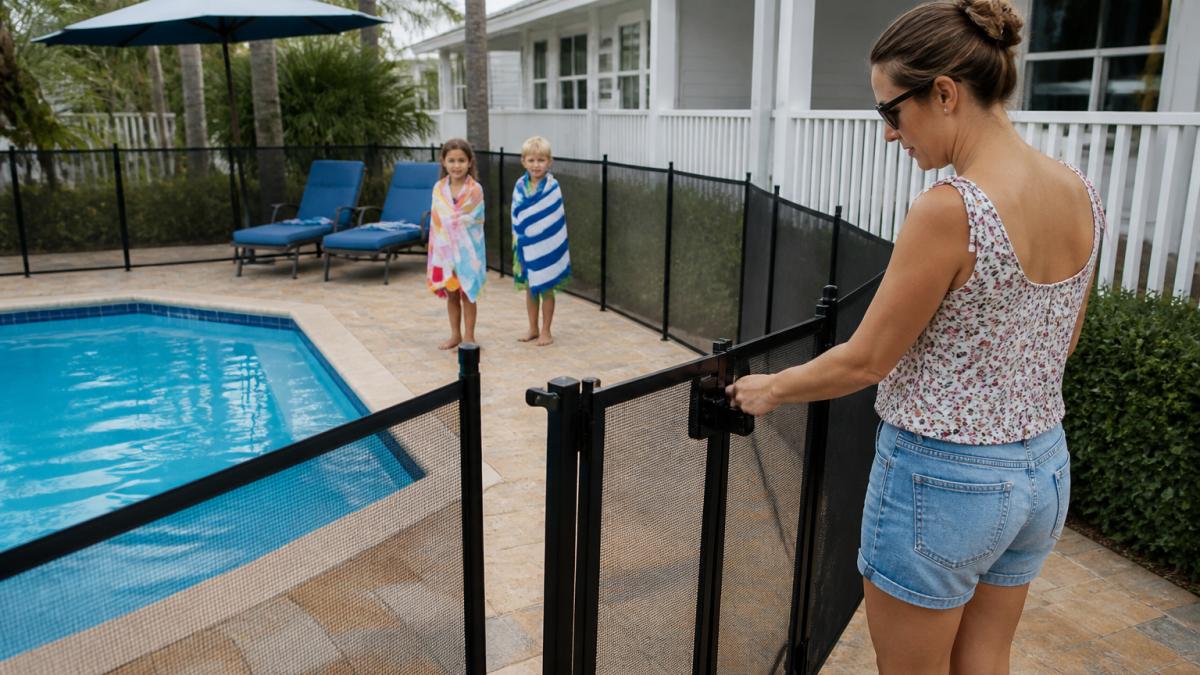
Walk the pool area in this order:
- Test every gate. Open it halfway and let go. It should close and latch.
- Check every pool-facing door. Confirm the lock and alarm work.
- Look for gaps in the fence and anything climbable against it.
- Find the rescue equipment and confirm it's within reach.
- Check the pool alarm if there is one.
- Agree on the watcher schedule before the first swim.
- Walk the path to the beach and note the hazards there too.
That last step matters. A beach rental puts ocean waves and rip currents in the same trip as the pool. Assess both risks together and set beach rules the same way you set pool rules.
When a Rental Lacks Adequate Barriers: Your Options
A rental without proper barriers is not a dealbreaker if you act early. Your options, in order of preference:
- Ask the host to fix it before arrival. Most will add a gate latch or arm an alarm.
- Ask for a different property. If the host has another unit with a full barrier, request it.
- Add temporary barriers yourself. A pressure-mounted gate or a door alarm you bring can close the gap.
Booking a beach rental with a private pool means taking on a job the listing never mentions: you are the safety system. Cozy Canaveral Cottages offers a private, three-cottage property just over a block from the beach, with a private pool and outdoor recreation area, and space that suits couples and families alike. Get in touch with Cozy Canaveral Cottages and book a stay.
Frequently Asked Questions
What should I check before booking a vacation rental with a private pool?
Ask the host to confirm four things in writing: a fence or barrier that fully separates the pool from the house, a self-latching and self-closing gate, alarms on doors that open to the pool deck, and any pool alarm or cover. Request current photos of the barrier, not just the water view. The CPSC reports awareness of at least 64 fatal and non-fatal pool drownings in vacation rental homes involving children under 15 since 2021, so treat barrier details as a booking requirement, not a bonus.
Should a vacation rental pool have a fence or safety gate?
Yes. A barrier that separates the pool from the rental is the single most reliable layer of protection when an adult is not watching. Look for a fence with no climbable handholds, a gate that closes and latches on its own, and a latch mounted high enough that a toddler cannot reach it. If the listing does not mention a fence or gate, ask directly and get a photo before you pay a deposit.
What pool safety equipment should a family beach rental provide?
A well-equipped rental should have a reaching pole, a ring buoy, door or gate alarms, and a pool alarm or floating alarm if the pool is uncovered. Ask whether the host provides these or whether you should pack your own. For toddlers, bring a properly fitted life jacket rather than relying on inflatable arm bands. Confirm what is on site before arrival so you are not searching for rescue equipment on your first evening.
What should I do if a rental pool has no fence?
Contact the host immediately and ask what barriers can be added before you arrive. If nothing changes, set your own rules: keep doors to the deck locked, assign a designated water watcher for every pool session, and never let children on the deck unsupervised. Document the missing barrier in photos and messages. In some areas local rules require barriers for rental pools, so ask the host which regulations apply and whether the property is compliant.
CONTACT US